
Before CardTraq, network fees were a black box. Now, we have a clear monthly view of every charge, and can challenge unexpected items with confidence. We've already saved seven figures and strengthened our merchant pricing.
CardTraq is the payment economics business behind your card program: senior practitioners who have worked inside the networks, issuers, and processors, paired with proprietary technology and analytics. We cut your network fees, along with interchange and processor costs, and keep the economics managed as your program grows.
We typically identify 7 to 15 percent of network spend in potential savings. For a mid-sized program, that is already seven figures. For larger issuers and acquirers, more.

 Business
~30% unit cost increase over the last 5 years; network fee optimization can make the difference between winners and losers in the market.
Consolidating and analyzing fees is complex, especially for large organizations; 100's of new fee related bulletins are introduced regularly, often opt-out.
~50% of network costs are universal, i.e. not directly linked to a transaction, and need to be apportioned to inform business decisions.
Interchange misqualification remains a persistent source of margin erosion for acquirers, driven by configuration gaps and inconsistent transaction data quality.
Two purpose-built platforms that categorize every Visa and Mastercard fee, backed by senior consulting and a managed service when you want our experts running the work with you. Built for issuers, acquirers, and BIN sponsors that need to know exactly where their network economics stand.
Monitor every Visa and Mastercard network fee. Identify cost drivers, eliminate unnecessary charges, and forecast fee changes, saving clients millions annually.
Break down interchange fee drivers, quantify optimization opportunities, and improve P&L forecasting accuracy. Purpose-built for issuers and acquirers.
Tailored engagements delivered by senior practitioners. From standard reviews to custom consulting when your challenge doesn't fit the standard shape.
Ongoing engagements where our experts operate the work with you.
Our clients, including some of the world's leading payment card organizations, have identified potential network fee savings of 7-15%, reduced interchange costs by 2-7%, and improved cost recovery by up to 50%, based on prior client analyses and dependent on portfolio mix and volumes.
Alongside network fee tracking, interchange tracking and custom consulting, we partner with Rivero to offer Kajo, a dedicated platform for network compliance. Visa and Mastercard have published over 2,000 network bulletins in the past year, each carrying changes with real deadlines. Kajo pre-analyzes every bulletin, filters it to your licenses and turns it into assigned tasks, cutting the manual workload for compliance teams.
Centralize all payment network references and manuals in one hub. Kajo highlights relevant mandates and their impact so nothing gets overlooked.
Auto-assess impact, prioritize actions, assign owners, and track progress from publication to completion with a full audit trail.
Kajo's built-in intelligence provides instant summaries, answers, and role-specific guidance to enable you to make faster, smarter decisions.
Kajo is created by Rivero, and CRG is their strategic partner in the Americas. Looking for compliance rather than fee tracking? This is the place to start.
Explore Kajo










Before CardTraq, network fees were a black box. Now, we have a clear monthly view of every charge, and can challenge unexpected items with confidence. We've already saved seven figures and strengthened our merchant pricing.

CardTraq helped us uncover hidden fees and gave us the transparency we needed to streamline our cost structure. It's rare to find a tool this powerful that's also this easy for a bank to use.

CardTraq turned fee optimization from a manual slog into a strategic advantage. We now track trends across multiple regions and products, spot anomalies early, and make more informed decisions.
Want the detail behind results like these?
See our client case studiesCan you clearly explain what you are paying Visa and Mastercard in network (scheme) fees, and what is driving those costs? If not, you are not alone, and the opportunity is usually larger than expected once the drivers become visible.
Our free guide explains how Visa and Mastercard network (scheme) fees work, how they are assessed, who pays them, and why they continue to rise faster than payment volumes.
Get our fee explainer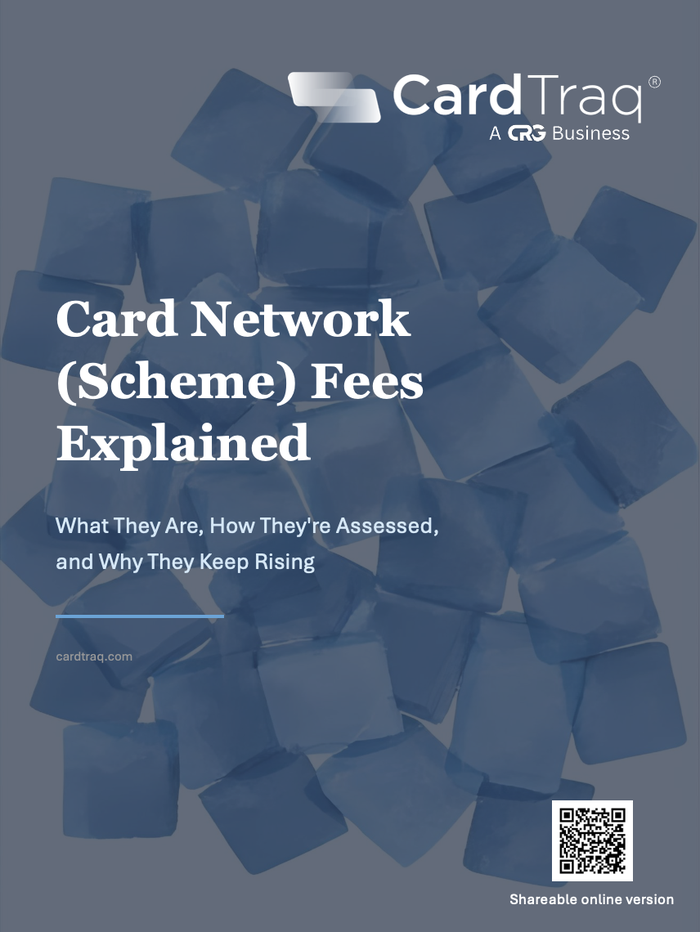
In-depth articles from Steven Leitman on card network economics, interchange, and compliance strategy.
Most issuers and acquirers have potential network fee savings of 7-15% to uncover, depending on portfolio mix and volumes. CardTraq gives you the visibility to find them. Book a personalized demo and we'll show you exactly where your overspend is hiding.